
Introduction
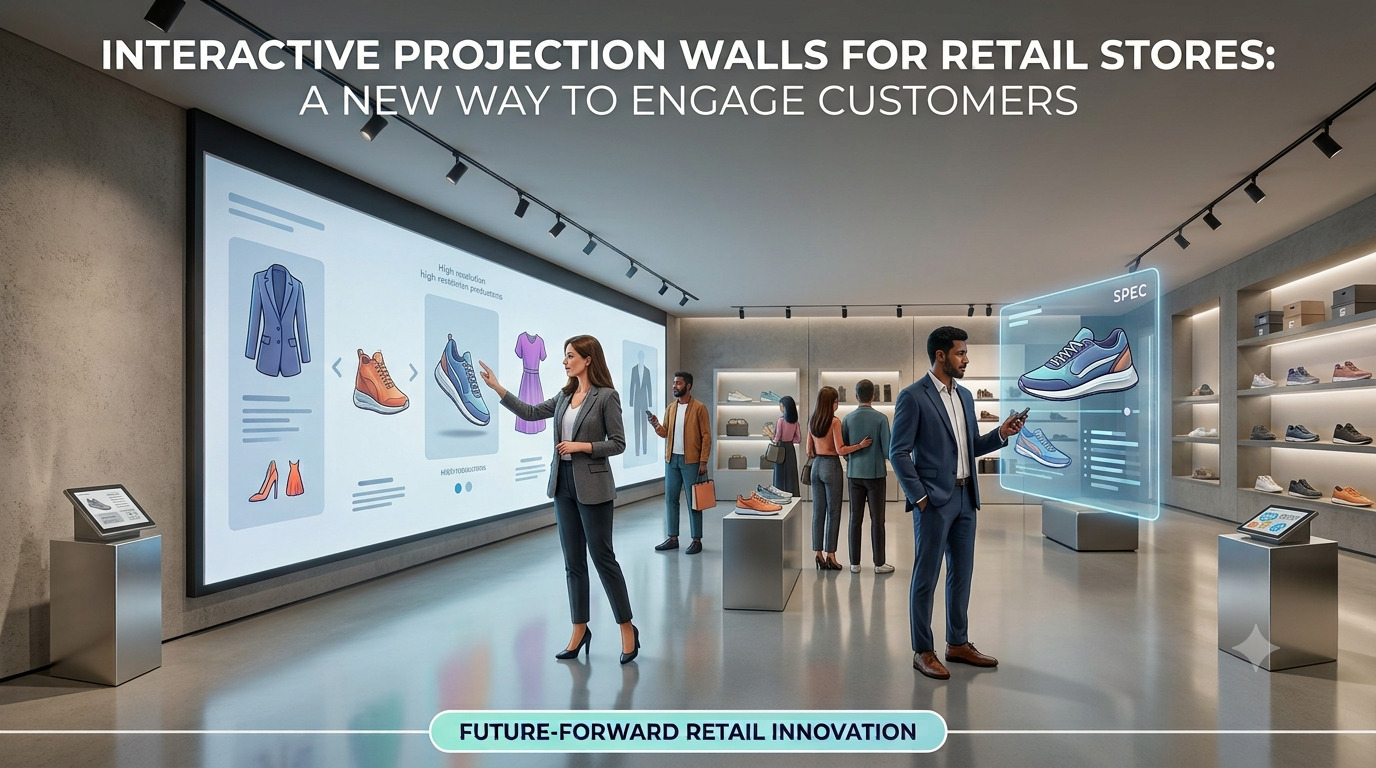
Retail stores are always looking for innovative ways to engage customers and drive product discovery. Interactive Projection Walls create immersive digital experiences. Businesses can use static displays to share important information with customers. However, interactive visuals can be instrumental to engage customers more effectively.
Instead of allowing customers to view projected information, encourage them to take part in a dynamic experience. This can ensure that product, offer, or brand information is memorable and impactful.
Interactive projection walls can be a unique way for retailers to reach out to their customers. In addition, it can also be a novel way of transforming retail environments.
Curious about the technology? You can also refer to our guide, What is Interactive Wall Projection and How Does It Work? , to know more about the technology.
Quick Answer Summary
Interactive Projection Walls can transform empty retail walls into engaging digital experiences using a combination of projectors, sensors, and software. This allows customers to interact with the visuals they cast on the wall.
Retailers can use Interactive Projection Walls to:
- Drive attention inside the retail store
- Display products innovatively
- Promote offers and new launches
- Allow customers to interact
- Offer immersive customer experiences
- Share brand-related content and stories
- Drive experiential marketing
- Make optimal use of retail space
Most importantly, the retailers can personalise the experience as per their requirements and marketing objectives.
Detailed Explanation
Why Interactive Projection Walls for Retail Stores?
There are a number of challenges that retail stores face in terms of marketing and engaging customers. One, advertisements bombard customers on a daily basis, and traditional marketing and retail displays fail to engage them. Interactive Projection Walls can offer a new way of showcasing content by encouraging customers to interact.
For instance, a clothing store can use Interactive Projection Walls to advertise their products differently. Projected models can help the customers discover different products by interacting with the wall.
In a similar manner, furniture stores can advertise their products by projecting different room settings and allowing customers to visualise the products in different room decor.
Create Immersive Product Experiences
It is not necessary to put up static boards with product information. Instead, use a dynamic digital experience to display important product details. For instance, a projection wall can display the product description, features, benefits, images, and videos. This allows customers to freely explore the information they want. More importantly, retailers can also make use of Interactive Product Displays to make the product discovery process more interesting and engaging.
Make Brand Campaigns Memorable
The objective of effective marketing in retail stores is to create a memorable experience for customers. Interactive projection can be a great way to support a brand campaign through visual content. For instance, brands can share new product launches and seasonal campaigns in the form of animation and other visual effects. In addition, interactive projection can be used to share a brand’s story and values.
More importantly, businesses can leverage this technology in sync with their broader marketing strategy, and create a uniform brand experience for customers, both online and offline.
Drive More Customer Participation
Interactive experiences are a great way to get customers to engage with a brand. A customer discovery game could be an effective way to get customers to explore products. Alternatively, you can also think of creating interactive quizzes and recommendations. Such experiences can pique the curiosity of the customers and motivate them to explore more.
Interactive Experiences to Support Retail Promotions
Interactive projection walls can be an innovative way to promote new products, offers, and other retail initiatives. A store can use its walls to advertise seasonal offers and new product launches through animation and interactive visuals.
Moreover, interactive experiences are bound to draw the attention of customers. The retailers can keep changing the content as per their requirements and marketing objectives. This makes Interactive Projection Walls, an ideal way to promote products.
Make More of Your Retail Space
Most retail stores have several empty walls that they cannot use for anything. Interactive projection walls can transform these empty spaces into screening platforms for digital content.
The retailer has the flexibility to decide on the content that would be relevant for their target audience. Also, they need not invest in putting up physical displays. Instead, a digital experience could be created on an existing wall.
Step-by-Step Process
1. Define the Objective
The first step is to decide on the objective of the Interactive Wall Projections. The objective could be anything from product promotion to brand storytelling and entertainment value.
2. Choose the Ideal Space
The next step is to choose the ideal space for the projections. This could be an existing wall or any other suitable surface.
3. Think Through the Nature of Interaction
Now, decide on the type of interaction that would be required for the customers to participate. For instance, you could decide if the interaction would be gesture-based, movement-based, touch-based, etc. Also, keep in mind that the interaction should be intuitive to ensure that the customers are able to engage with the wall easily.
4. Decide on the Content
After deciding on the interaction, create interesting content that would support your marketing objective. Keep in mind that you can use motion graphics, animation, product images, and more. However, you should avoid displaying too much information at the same time.
5. Install and Set the Technology
Now, it is time to set up the projectors, sensors, and software. This is an important step since you need to ensure that the technology is sensitive enough to respond to the interaction of the customers.
6. Test the Interactive Projection
Before officially launching the projection, test it to ensure that you display the visuals correctly. The testing will also help you make the necessary adjustments. Also, make sure that there are no issues with the interaction and response.
7. Launch and Keep Refreshing
The final step is to launch the projection and keep updating the content regularly. You could update the content as per new products, offers, and more. This will ensure that the interactive projection is effective in meeting your objective.
FAQs
What are Interactive Projection Walls?
Interactive Projection Walls use a combination of projectors, sensors, and software to create interactive digital experiences on walls. This allows customers to interact with the projected content.
How can retail stores benefit from Interactive Projection Walls?
Retailers can advertise products, promote offers, brand campaigns, and more using Interactive projection walls and can leverage this immersive experience to drive brand engagement and create sceneries that resemble a retail store.
Can Interactive Projection Walls be used to encourage customer participation?
Interactive visuals can be a great way to advertise products. However, there are concerns about whether such visuals drive true customer engagement. Businesses can use Interactive Projection Walls for visual content and to encourage customer interaction. However, there are no guarantees unless you take the initiative to engage customers.
Can content on Interactive Projection Walls be updated?
Yes, the content on Interactive Projection Walls can be updated to reflect new products, promotions, and more. You can change it as per your marketing requirements.
Can Interactive Projection Walls be installed in small retail stores?
Yes, Interactive Projection Walls can be installed in small retail stores. However, the size and space needs to be taken into consideration while finalising the location. Ideally, there should be enough lighting, there should be scope to have the required size of the wall, and customers should be able to walk around the location easily.
Can Interactive Projection Walls be used for promotional campaigns?
Yes, Interactive Projection Walls can be used for such initiatives. There are multiple ways in which a retailer can use it for promoting products and services. The most common applications include product launches, seasonal offers, and special campaigns.
What determines the cost of Interactive Projection Walls?
The cost of Interactive Projection Walls depends on a number of factors. These include the range and quality of the projectors, the sensors and software, the complexity of the content, installation costs, size, and more. However, you can request a customised quote to get a better idea in accordance with your needs and requirements.
Can Emaginationz Technologies help in developing interactive projection walls?
Emaginationz Technologies has the expertise and experience to develop interactive wall projection solutions. We understand that an interactive experience goes beyond visual content. We can work with you to develop a customised solution based on your business requirements and target audience.
Conclusion
The retail environment is witnessing a paradigm shift towards immersive experiences. Interactive Projection Walls can be a novel way for retailers to advertise their products and services. There is also the advantage of being able to update the content as per one’s requirements. However, the most important consideration when investing in such an experience is to ensure that it aligns with one’s business objective and is capable of delivering the intended result.
If you are looking for a way to create an immersive customer experience in your retail store, Emaginationz Technologies can help you design and develop a customised interactive projection experience.
One thought on “Interactive Projection Walls for Retail Stores: A New Way to Engage Customers”